
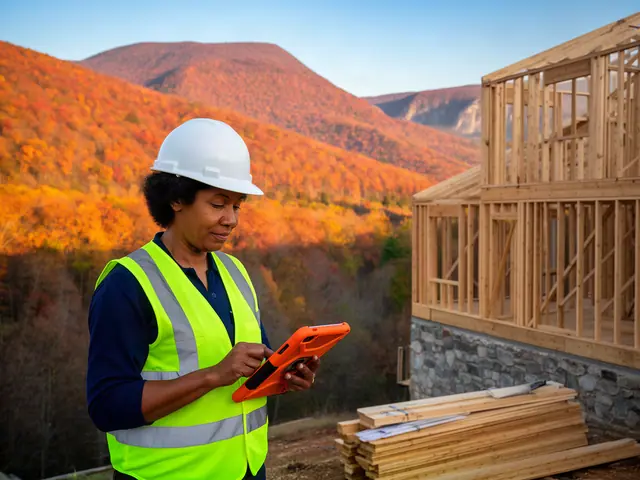
Wrenmoor Funding, a small-business funding service in Chattanooga, TN, places requests from Hamilton County, TN general contractors, home builders and specialty trades with funding partners. Typical needs are materials before a draw, payroll during retainage and machines for the next job; partners review backlog, bank records and the equipment itself.
| Builders and trades with a payroll (county) | 789 (CBP 2023) |
|---|---|
| Firms with one to four workers | 52.3% (CBP 2023) |
| Paid employees | 10,834 (CBP 2023) |
| Construction nonemployers | 3,596 (NES 2024) |
Why Builders Run Short on Profitable Jobs
A construction job spends money in a fixed order: deposits on materials, crews every week, equipment rentals or payments, then the first progress payment after an inspection or a pay application is approved. Many contracts also hold back retainage, a share of each payment kept until the job is complete. A profitable job can therefore run a cash deficit for most of its life.
That pattern is why construction cash flow is the topic most contractor funding requests are really about. The work is real and the receivable is real; the money simply arrives after the bills.
Hamilton County, TN Builders in the 2023 Count
Construction had 789 employer establishments in Hamilton County, TN in 2023, with 10,834 paid employees and $825.3 million of annual payroll; 52.3% of those firms had fewer than five employees (U.S. Census Bureau, County Business Patterns 2023). By our arithmetic that is about 13.7 employees per establishment and roughly $76,200 of payroll per employee.
| Sub-sector (NAICS) | Employer establishments | Firms with one to four workers |
|---|---|---|
| Residential building (2361) | 190 | 70.5% |
| Plumbing and HVAC (238220) | 125 | 40.8% |
| Nonresidential building (2362) | 64 | 26.6% |
| Electrical contractors (238210) | 62 | 46.8% |
| Roofing contractors (238160) | 29 | 65.5% |
Separately, Nonemployer Statistics counted 3,596 construction businesses with no paid employees in 2024; it is a different program and year, so it is not added to the employer count. ZIP 37406 alone had 56 construction employers in 2023 (ZBP).
Business Loans for General Contractors
A general contractor carries the widest gap: subcontractors and suppliers expect payment on their terms while the owner pays on the draw schedule. A business line of credit fits that pattern, because draws follow the job and paydowns follow the progress payments. For a single known shortfall, such as two payrolls before a draw, working capital is simpler.
A draw-gap example (illustrative only)
A sample builder has a $46,000 progress payment approved, payable in 30 days, with 10% retainage held. Materials for the next phase cost $18,500 now, and two weekly payrolls of $7,900 fall before the draw. The gap is $34,300; the draw nets $41,400 after retainage. Numbers are invented to show the arithmetic, not an offer.
Financing Excavators, Skid Steers and Trailers
Machines are the second big need. A business loan for construction equipment, or a lease, usually sits under equipment financing, where the machine secures the deal. Used excavators, skid steers and trailers are common; partners look at hours, condition and the seller. Run the numbers first with the construction equipment finance calculator, and for a smaller purchase read the post on financing a welding machine.
Trades Split Out Onto Separate Pages
Plumbing and HVAC contractors have their own page because their cash cycle mixes service calls with project work. Plumbing and HVAC contractor funding covers vans, parts stock and service agreements, with the county's NAICS 238220 figures. Electrical, roofing, landscaping and other trades are summarized on the industry index.
What a Partner Opens First in a Contractor Request
- The contract or backlog behind the request
- Pay applications, draw schedules and retainage terms
- Bank statements from the last few months
- Equipment quotes, with year and hours for used machines
- Machine payments and lines already running
No partner publishes minimums; each sets its own, and no backlog size or contract value assures an offer.
Questions to Settle Before Signing a Funding Offer
- Does the repayment start before or after the next draw is expected?
- Is the lien general, or tied only to the machine being bought?
- What happens if retainage is released late?
- Can the line be paid down early without a charge?
- Will the payment still work if a job is delayed by a month?
Contractors who answer these before signing tend to pick the structure that matches the job, not the one offered first. Partners expect the questions and set out the answers in the offer documents.
Construction Cash Flow on a Single Draw (Illustrative Only)
A sample builder's draw schedule pays $45,000 when framing passes inspection. Lumber ($18,000) was paid on delivery, and the framing crew ($14,000) was paid weekly through the job. The draw request goes in, the inspection is scheduled, and the money arrives after the lender's review, so $32,000 sits out of pocket for several weeks. The numbers are invented to show the shape, not a typical job.
Permits as a Pipeline Signal
Hamilton County, TN authorized 2,043 new residential units in 2023, 2,130 in 2024 and 1,887 in 2025 (Census Bureau Building Permits Survey). For a subcontractor, those counts are a rough read on future bids; for a funding request, the pipeline that matters is your own signed contracts and their draw dates.
Before You Bid the Next Job
Commercial projects and build-outs depend on zoning and permits being settled first; the Chattanooga, TN zoning and permit guide lists what to confirm. County context sits on the Chattanooga, TN page, and the industry index covers the other trades.
By Wrenmoor Funding · Updated